Subscribe to Science Friday
Science fiction nerds, rejoice: The long-awaited adaptation of “Project Hail Mary” is in theaters now. The 2021 book is considered one of the best science fiction books of the 21st century (and according to the New York Times, one of the best books, period). It follows failed molecular biologist and middle school teacher Ryland Grace on a solo journey to save the world from a microbial alien species that is slowly, but surely, dimming the sun.
While the film stars Ryan Gosling as our human protagonist, the real star of the show is Rocky, a five-limbed, Labrador-sized creature with no face that looks like a tarantula made of rocks (see him in this trailer at 2:37) . We talked to “Project Hail Mary” author Andy Weir, and astrobiologist Dr. Mike Wong, about Rocky’s biology, and how he bucks the trend for how we typically envision aliens.
Rocky on film
Rocky, an alien from the planet Erid, is very cute, thanks to puppet designer and performer James Ortiz. But was he what Andy Weir imagined him as he wrote the character?
“The truth is I don’t have a very visual imagination. So when I’m writing, the characters are just sort of blobs,” Weir said. “I knew that he’s got a thorax, and five legs, and there’s joints and three fingers at the end of each hand. But I couldn’t have told you whether his legs were skinny or wide, or if they were bumpy or smooth.”
Seeing the puppet design made everything click into place for Weir, who was more concerned with Eridian species morphology and biology. “ I spent a lot of time going down that rabbit hole because speculative evolution is fun.”
Rocky’s biology
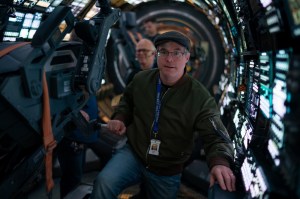
Weir imagined Eridians as self-contained biospheres that operate without inhaling or exhaling. Instead, they’ve got a personal oxygen-to-carbon dioxide exchange system. That meant their communication style couldn’t be based on traditional mouth sounds.
“[Eridians] have basically air bladders that push across vocal cords back and forth to make sounds,” Weir said. “They have five of them because everything is pentasymmetrical in Eridian biology, because I arbitrarily decided it would be. And so they can make chords.”
The result is that Rocky sounds more like a whale than anything human-adjacent. Rocky and Ryland find ways to communicate via a fancy computer translation system, but it isn’t easy because, well, they’re aliens to each other.
“ I wanted [Rocky] to be completely incompatible with all things human,” Weir said. “Like, if you put an Eridian in a human air atmosphere, he’ll die. If you put a human in an Eridian’s atmosphere, he’ll die.”
Could aliens like Rocky exist?
Astrobiologist and planetary scientist Mike Wong is a big fan of Rocky’s non-traditional look, because it points to the fact that evolution is often random.
“Things like body plans, what kind of symmetry you have, those could be locked in early on due to a chance mutation,” Wong said. “And then from then on out, you’ve got fivefold symmetry instead of bilateral symmetry, or something like that.” But, he points out, the true breadth of possibilities for evolution could be much broader than what we see on Earth.
Weir agrees, and says the extreme differences between Rocky and human protagonist Ryland have parallels to life on Earth.
“Even on Earth, in our own biosphere, if you exchange the positions of a shark and a camel, they’re both gonna die,” Weir said. “So something that evolved on another planet is almost certainly not gonna be compatible with us.”
Worth the watch?
If you like big, bombastic, and beautiful science fiction, then absolutely. My main takeaway after leaving the theater was that this film is visually stunning, from the sets, to the depictions of space, to Ryan Gosling’s fantastic head of hair. “Project Hail Mary” is Science Friday-approved.
— Kathleen Davis, SciFri Producer
This is an article from our newsletter “Science Goes To The Movies.” To get a story about the science of popular movies and TV in your inbox every month, subscribe here.
Donate To Science Friday
Invest in quality science journalism by making a donation to Science Friday.
Segment Guests
Mike L. Wong
Dr. Mike Wong is an astrobiologist and planetary scientist at the Carnegie Institution for Science in Washington, D.C.
Andy Weir
Andy Weir is the author of “Artemis,” “The Martian,” and “Project Hail Mary.” He’s based in Mountain View, California.
Segment Transcript
[MUSIC PLAYING] FLORA LICHTMAN: Hey, it’s Flora Lichtman, and you’re listening to Science Friday. Happy big budget sci-fi movie release day to all who celebrate.
[MUSIC PLAYING]
SPEAKER: If we do nothing, everything on this planet will go extinct, including us.
FLORA LICHTMAN: Project Hail Mary comes out this weekend. You may have seen ads of a dazed Ryan Gosling in a spacesuit. Or maybe you know the book that it’s based on. Here’s the premise. A microbial alien species is dimming the sun, and the Earth is going to turn into a frozen, lifeless tundra unless someone figures something out, and quick. The solution? Put failed molecular biologist and middle school teacher Ryland Grace on the case.
RYLAND GRACE: I put the “naut” in astronaut. I’ve never done anything. I’ve never done a spacewalk. I can’t even moonwalk!
FLORA LICHTMAN: This is your warning there will be spoilers. So our protagonist finds himself in space. He meets a new buddy, Rocky, an alien from the planet Erid, who is very cute, despite having no face and looking like a pile of rocks. It is super fun to see a scientist and his alien sidekick try to save the world. And the movie raises lots of interesting questions about alien life, which is why I’m so happy we’re talking about it with the perfect guests, author of the book Project Hail Mary and The Martian, Andy Weir, and astrobiologist and planetary scientist, Mike Wong. Andy and Mike, thanks for being here.
ANDY WEIR: Thanks for having me.
MIKE WONG: Yeah, this is going to be fun.
FLORA LICHTMAN: OK, Andy, kick us off. This story is your baby. It must be so gratifying to see it come to life and executed in such a fun and beautiful way.
ANDY WEIR: Yeah, it’s amazing. I mean, to see just hundreds of world-class people putting all of their effort into making this thing that fell out of my head a reality is– it’s pretty humbling, actually.
FLORA LICHTMAN: OK, so given that, I’m going to ask you to put on your petty writer hat. What is the tiny, little thing we can all look out for in the movie that you would have done differently?
ANDY WEIR: Huh. Well, I can’t really think of anything that I would have done differently. There are a few tiny little things like, oh, there’s– this scene would have been a good opportunity to do this thing. Or there’s some omissions from the book that– obviously, only like 5% of the book is going to make it into a movie. But I wish there were a couple of scenes in the book that aren’t in the movie that I’m like, ah, it would have only been a couple of minutes. We could have added it. But I don’t have any specific gripe. I think it’s a great adaptation that came together really well. I know that sounds like a cop-out, but that’s just genuinely how I feel.
FLORA LICHTMAN: It does sound like a cop-out, but I understand.
[LAUGHTER]
What was your level of involvement?
ANDY WEIR: I was very involved. I was a producer on the film, so I was there for the whole shoot. And I was always– like, Ryan considers the screenplay to be sort of a vague suggestion. And so, he’d ad-lib and stuff like that. And–
FLORA LICHTMAN: Ryan Gosling.
ANDY WEIR: Yes, Ryan Gosling. Yeah, and so a lot of the takes that are in the movie are things that he just ad-libbed and stuff like that because he came up with better versions than what we wrote.
FLORA LICHTMAN: Can you think of an example? Is there one that comes to mind?
ANDY WEIR: Ah, I mean, [LAUGHS] just generally, like the phraseology and just like how he phrases things. One thing is when Rocky is rolling around in his lab and stuff like that, he’s like, Rocky, Rocky, Rocky, my hand is up. That was all him. And there’s another line where he’s going through potential voices for the voice synthesizer for Rocky. And he just ad-libbed [LAUGHS] Meryl Streep, man, she could play anything. He just ad-libbed that.
FLORA LICHTMAN: That was a great line, actually. I do remember that.
ANDY WEIR: So, yeah. And then we went and asked the real Meryl Streep if she could read a line for us for the movie, and she agreed. So yeah, we got to do that. That was pretty cool. And like I said, Ryan would go off script a lot, so I’d go up and whisper to the directors. I’m like, OK, he said milligram when he should have said nanogram– that sort of thing. [CHUCKLES] They’ll get it right on the next take.
FLORA LICHTMAN: OK, Mike, what about you? You saw the movie, right?
MIKE WONG: I did, yes.
FLORA LICHTMAN: What did you think?
MIKE WONG: I absolutely loved it. It was just such a joy to watch. I mean, I also read the book. And I’ve got to say, I know the book came out several years ago, but I only got around to reading it last May because we run the summer internship program at my institute, Carnegie Institution for Science, and the intern that we had admitted to the program last summer wrote in their application, Project Hail Mary by Andy Weir inspired me to want to be an astrobiologist. And when we admitted this person into the program to work with me, I was like, I guess I got to read this book now to know what the kids are getting inspired by to go into my field.
FLORA LICHTMAN: The main character of this story, Ryland Grace, is kind of an outsider scientist. He’s been sort of shunned by the establishment. Mike, I’m curious, when you see a scientist portrayed that way, what do you make of it? How does it make you think or feel?
MIKE WONG: I really identify with Ryland Grace. I’m an astrobiologist. And Ryland’s big thing, the reason why he’s shunned is because he wrote his dissertation about life that is not water-based at all. And I’ve actually written papers about how we should stretch our definitions of life, such that we would be attuned to looking for life that doesn’t follow the same characteristics as life on Earth, including life that may not be water-based or carbon-based or use ribosomes or mitochondria, et cetera, et cetera.
And so I really identified with that aspect of Ryland. I also really identified with his love for teaching. That’s something that I’m also very passionate about, too. So I saw myself in this character. And when I see somebody like that shunned by his community, I think about all the times that people have really raised eyebrows at me and the rest of the astrobiology community, thinking, is that a real science?
I mean, how can you even do astrobiology when you haven’t yet found signs of life in space? To which I’ve developed a kind of funny answer, which is, I tell them, oh, but we have found life in space. And people’s eyes widen, and their jaws drop. And they wait with bated breath for me to divulge some state secret about where we’re keeping the alien bodies.
ANDY WEIR: Right here on Earth.
MIKE WONG: Yeah, [LAUGHS] exactly. No, Andy’s with it. I just remind them, you’re life in space. We’re all life in space. When we discovered that our planet was an inhabited world, that our entire biosphere was on the crust of this regular, rocky world, orbiting a very ordinary star in one of a trillion galaxies in the observable universe, we discovered life in space. And the great question that we get to ask now is, is there more of us out there?
ANDY WEIR: And I’ll go ahead and own up to this, which I knew at the time that I was writing, is that I portrayed Grace’s view as like, life doesn’t need water, as being this radical idea that partially got him– that got him ridiculed within the community. But it is actually a commonly held theory by many, many astrobiologists. I just wanted something that the reader could understand that would explain why he left academia.
FLORA LICHTMAN: Andy, do you identify with Ryland as the outsider or not anymore? Are you too big now?
ANDY WEIR: I’m too big. I mean, you guys are lucky I’m here, frankly. No.
FLORA LICHTMAN: [LAUGHS]
ANDY WEIR: I mean, I always feel like an outsider. I think everybody always feels like– maybe that’s just me projecting onto everyone else. But I always feel like I’m an outsider wherever I am. And I reject that, although I will take a step back and say, Ryland is the first time I made a main character that wasn’t just directly based on my own personality.
FLORA LICHTMAN: Really?
ANDY WEIR: Yeah, Mark Watney from The Martian is all of the aspects of myself that I like magnified, and then all the aspects of myself that I don’t like erased. So he’s the idealized, perfected version of me. Jazz Bashara from Artemis, also known as Andy Weir’s other book, is sort of an amalgamation of all of the flaws I had when I was her age– theoretically very smart, yet still making bad life decisions. And most of her problems are things that she brought about and stuff like that.
FLORA LICHTMAN: Self-created. We can all relate to that, too.
ANDY WEIR: Yeah, and so that was based on me as well. People, turns out, they like the pretend, idealized version of me more than the more realistic version of me. Everybody likes Mark. People didn’t like Jazz that much. But then Ryland was the first time I decided, OK, I’m going to try to make a character that isn’t based on my own personality.
So I started off with a core central thing of like, OK, what makes him a little different than most people is he is so pathologically conflict-averse, like almost a phobia of conflict, that he would rather leave his profession than defend his theories. And he retreats to the safety of a middle school teacher, where the children aren’t going to challenge him, you know? And he’s the cool teacher and all this stuff like that. And he’s afraid. And I think feeling overwhelmed and afraid, well, that’s something we all can really get behind. I think we’ve all been there.
FLORA LICHTMAN: Yeah, and don’t downplay being a middle school teacher, because that actually seems like one of the most frightening and difficult jobs I can think of.
ANDY WEIR: But the point is, he went into an environment where he went out of his way to be like the cool teacher that the kids like, right?
FLORA LICHTMAN: Yes.
ANDY WEIR: I mean, and he loves to educate kids, but it was really important for him to be beloved by the kids. And a lot of teachers will tell you, OK, it’s nice if the kids like you, but it’s more important that the kids learn. [LAUGHS]
FLORA LICHTMAN: Yes, right. True enough. We have to take a break, but don’t go away because we’re going to get to my favorite part of the movie– the aliens! Stay with us.
[MUSIC PLAYING]
[MUSIC PLAYING]
FLORA LICHTMAN: I’m so excited to talk about the aliens. I want to start with the microbial, sun-eating species that sort of kicks off the drama here. Andy, what was your inspiration around that form of alien life?
ANDY WEIR: Astrophage? Yeah, this all started off with I wanted to come up with a story where humanity had access to a mass conversion-based fuel, because if we had that right now, we’d be able to colonize the solar system now. It would be easy. Because we have the energy. The problem is storing the energy in a small enough volume and mass that we can use it for spacecraft.
And so I was like, I want us to have that now. But it’s way beyond our technology to make right now. So it’s a bit too much suspension of disbelief to have some mad scientists invent it. Then I went through a phase where I’m like, maybe they find a crashed alien spaceship, but then it’s like, OK, then the other stuff on the spaceship would probably be even more interesting than the fuel, and I don’t want to focus on that.
And then I thought, well, maybe it’s like– maybe they find some fuel. Maybe they find a crashed alien spacecraft, and everything’s all completely rotted because it crashed here like a billion years ago, but the fuel is still good. And maybe the fuel makes more of itself. Maybe it’s a reversible reaction. So you can shine light on the fuel, and it’ll absorb it and start turning that into mass and something like that.
And then I said, absorbing energy and making more of yourself sounds like life. That’s what plants do. So I thought, OK, what if it’s a biological entity? What if it’s not like aliens who say, take me to your leader? What if it’s just an invasive species, basically? And so I said, oh, OK. So then we have single-celled organism that does mass conversion for storing energy. And then I’m like, why? Why would it do it– why would anything evolve that? And how would it get that much energy?
And I said, well, it doesn’t have to live on a planet just because we do. It lives on the surface of a star. People call it like oh, it’s eating the sun. They’re not eating the sun. They’re living on the sun. It’s like algae isn’t eating the ocean. It just lives there. And so it’s absorbing energy from the sun.
And I’m like, why? And I’m like, oh, so it can spore out to get the– so it can go out to get the things it needs to reproduce, because you can’t even find carbon and oxygen until you go like to the middle of a star. And so it would need to go somewhere else to breed and all that stuff like that. So the end result was I came up with Astrophage. And then I thought–
FLORA LICHTMAN: Andy, can I just pop in here? I love that this very gripping drama was reverse-engineered from the nerdiest possible starting point.
ANDY WEIR: Yep. I almost–
FLORA LICHTMAN: It’s delightful.
ANDY WEIR: Thank you. I almost always start with like, I want this science thing. How do I make this science thing happen in a story? Anyway, so I came up with Astrophage, and then I thought like, oh, OK– initially, I thought, oh, OK, humanity gets a hold of some Astrophage. And they’re like, oh, we can breed it up, and we can colonize the solar system and stuff like that.
And in the back of my mind, I was like, well, we better make sure we don’t let any of this crap get on our star, because that would be catastrophic. And then a few seconds later, I’m like, OK, wait. Erase everything else. That’s the story. So there we have it.
FLORA LICHTMAN: That’s amazing. Mike, as our resident planetary scientist and astrobiologist, what was your take on the Astrophage?
MIKE WONG: I love how the Astrophage sort of subverts a lot of expectations we have about encountering alien life. I mean, just contrast the Astrophage with the alien from the Aliens series. The aliens are these big, monstrous, macroscopic monsters that are coming and eating us, whereas the Astrophage is just a microscopic organism that isn’t even infecting us.
They’re just doing their business, minding their own business, absorbing sunlight and converting that into energy. And yet, they still present this extraordinarily scary doomsday scenario. Not one that it’s like immediate we’re going to all die because aliens are coming to eat us or infect us, but simply by dimming the sun. They are essentially, to me, an allegory for climate change. We can see our future decades out in advance, that if we allow this thing to keep going, our entire way of life is going to disappear.
FLORA LICHTMAN: OK, we have to talk about Rocky. So Astrophage are not the only aliens in Project Hail Mary. In my opinion, the star of the show– I’m sorry, Ryan– is Rocky, who becomes [LAUGHS] Ryland’s buddy.
ANDY WEIR: [LAUGHS]
FLORA LICHTMAN: Rocky is extremely charismatic, I think. And once they solve the language barrier problem with a kind of computer auto-translator, they’re off to the races. So, Andy, I loved Rocky’s look. He’s not humanoid at all. He’s like a rock tarantula, about the size of a golden retriever. Is this how you picture aliens in your mind?
ANDY WEIR: Well, so the truth is, I don’t have a very visual imagination. So when I’m writing, the characters are just sort of blobs. I put a lot of time and effort into working out Eridian morphology and biology. I went down that rabbit hole, because it’s–
FLORA LICHTMAN: Rocky’s an Eridian. That’s the planet that–
ANDY WEIR: Rocky is an Eridian, yeah.
FLORA LICHTMAN: Yeah.
ANDY WEIR: And I spent a lot of time going down that rabbit hole because speculative evolution is fun. [LAUGHS] I suspect Mike would agree. But I couldn’t have told you a visual image of Rocky. I knew that, OK, he’s got a thorax, and he’s got like five legs. And there’s joints and three fingers at the end of each hand. But I couldn’t have told you whether his legs were skinny or wide or if they were bumpy or smooth. I just don’t have a very visual imagination.
So when I was seeing it in my mind, it was all just blobs. So it was kind of neat is when I saw, when they were shooting it, I went to the creature shop and saw the model and then saw the sets and everything like that. For me, I didn’t have the cognitive dissonance that a lot of writers have when they’re reconciling the screen version with what happened in their mind when they were writing it. For me, it’s just like, oh, so that’s what that looks like. Now I know. It becomes canon, you know?
FLORA LICHTMAN: I mean, so I also– because we’re an audio medium, and I think about sound a lot, I also was very interested in the sounds Rocky was making.
[ROCKY CHIRPING]
RYALND GRACE: That’s not bad.
FLORA LICHTMAN: Is there sort of internal logic to that? Did you come up with a language? If I do what Ryland does, would it be consistent throughout?
ANDY WEIR: I don’t think so. I mean–
FLORA LICHTMAN: Aw, I’m so disappointed.
ANDY WEIR: –I had made suggestions to the production. I don’t know if they followed it. But the reason Rocky sounds the way he sounds is because an Eridian’s body is basically like a self-contained biosphere. They eat food to power it and excrete whatever they don’t need, but they’re not exchanging air with the atmosphere. They internally have an oxygen, carbon dioxide exchange system going on within their own biology.
So because of this, they’re not breathing in and exhaling. So if they need to make noise, they need to do it inside their body. So they have basically air bladders that push across vocal cords back and forth to make sounds. And they have five of them because everything is pentasymmetrical in Eridian biology, because I arbitrarily decided it would be. And so they can make chords.
And I was like, what would that even sound like? Well, it would sound like whale song, because that’s what whales are doing. They’re pushing air from their lungs through their vocal cords into their mouths, then holding it there, and then re-inhaling it so that they can push it through again. So it’s like, [IMITATING WHALE SONG], you know?
FLORA LICHTMAN: I love that. Mike, as an astrobiologist, what did you think of the depiction of Rocky?
MIKE WONG: Well, first, I’m so glad that Andy admitted first that he’s not a visual person and just pictured a blob when he thought of Rocky, because that’s what I thought of, too, when I was reading the book, just this blob thing. But so I loved seeing Rocky come to life on the screen.
And who knows what kinds of very interesting different life forms can exist on other worlds, especially when those worlds, like Rocky’s, have a very different geology, and therefore, environment, that evolution would need to play with and navigate through to generate these highly evolved forms? And so, I love whenever science fiction gives us alien morphologies that look very different from us, because one thing that we think might be true about biological evolution is that it’s very path dependent.
Small decisions early on that we decided to use this particular molecule, like DNA, well, maybe not all life out there does use DNA as its genetic molecule. And then things like the body plans, what kind of symmetry you have, those could be locked in early on due to a chance mutation. And then from then on out, you’ve got fivefold symmetry, instead of bilateral symmetry, or something like that.
And so it’s great to play around with because I think the possibility space for the diversity of life in the universe is so much wider than the possibility space that was actually sampled through evolution here on this one terrestrial planet that we call Earth.
ANDY WEIR: And even then, like on Earth, the population of life is so incredibly diverse. So that’s one of the reasons I really wanted the alien in this story to be truly alien. I wanted it to be completely incompatible with all things human. Like, if you put an Eridian in a human atmosphere, he’ll die. If you put a human in Eridian atmosphere, he’ll die. They’re just completely incompatible.
And because it always a little bit bothered me in softer sci-fi, when the alien is just like a human with some forehead bumps. I get it, because that makes production easier. And it makes storytelling easier because you can directly interact, stuff like that. But I mean, even on Earth, in our own biosphere, if you exchange the positions of a shark and a camel, they’re both going to die. [CHUCKLING] So something that evolved on another planet is almost certainly not going to be compatible with us.
FLORA LICHTMAN: Yeah I mean, I thought that was a real feat of storytelling, that you could learn to love by the end a tarantula rock–
ANDY WEIR: Well–
FLORA LICHTMAN: –that could feel emotionally attached to it.
ANDY WEIR: Yeah, well, easier done in a novel than in a movie. So for me, anyone reading the novel just understands that Rocky is an entity that has feelings and stuff like that, and so you can be attached to him. It’s a lot harder in a visual medium. And the directors understood the assignment. They’re like, OK, we’ve got a creature made out of basically rocks that does not have a face, doesn’t have eyes, can’t make facial expressions at all, and we need the audience to love him.
FLORA LICHTMAN: Gestures were very important.
ANDY WEIR: Yeah, it was all just about body language. The puppeteers– James Ortiz was the head puppeteer and the voice. And they really did a fantastic job.
FLORA LICHTMAN: Mike, I know you read the book and saw the movie. I want to hear your astrobiologist, planetary scientist gripes. There have to be some.
MIKE WONG: I read the book. It was a joy. And I loved the movie. And really, it followed so much of the book. But there are a couple of things. One omission that I was a little disappointed to not see is the element of relativity, how Rocky’s species can’t see light. So they don’t have an understanding of light, and therefore, they don’t know about Einstein’s theories of relativity.
And that played an important part in the book in terms of the amount of fuel that was used, but also this idea of time dilation and space dilation. But it wasn’t really explored that much in the movie. And I was wondering, is that just because we don’t want to belabor the audience with that explanation? Or what was the reason for not landing on relativity too much?
ANDY WEIR: Well, I think one of the main reasons is because it wasn’t critical to advancing the plot. And you have to be laser-focused on that when you’re writing a screenplay, because you don’t have a lot of space and room, where we’re not going to stop the forward momentum of the plot to give an explanation of special relativity, or general relativity, as the case may be.
Now, we do mention, I think, that Ryland only experienced four years during his 13-year journey. So it’s there, and I know it’s there. Also, just minor correction to your quibble, Eridians absolutely know about light because they have scientists who have discovered it. They don’t have an organ to perceive light, but they know about it.
I often get– just, sorry, a random aside here– I often get emails like, how did the Eridians know about a Petrova Line? They can’t see light. I’m like, we can’t see infrared light either. But we knew about our Petrova Line. How do you explain that? It’s like science, technology. They worked this stuff out and found ways to learn about their environment and put it into a form that they can perceive. It’s not hard to follow.
FLORA LICHTMAN: Andy, is this the occupational hazard of writing mainstream sci-fi, where tons of smart people are like, well, actually?
ANDY WEIR: Yeah, it is. And not only that, but I’ll go the next step. I bring it on myself by writing hard sci-fi. So I tell people, hey, I wrote this to be as scientifically accurate as possible. And then the scientists are like, really? All right. OK.
FLORA LICHTMAN: Let’s go.
ANDY WEIR: Let me just pick up this gauntlet here and dust it off, and let me see what–
[CHUCKLING]
FLORA LICHTMAN: You have had several giganto hits. What’s next?
ANDY WEIR: I guess my next giganto hit. I don’t know.
[LAUGHTER]
No, I’m working on my next book now. I’m not talking details publicly, but I can tell you it’s science fiction, of course. And it’s not a sequel to anything.
FLORA LICHTMAN: It’s a safe space. We’re just– it’s just us.
ANDY WEIR: Yeah, it’s just us, and yeah. So everybody wants a sequel to Project Hail Mary, I get it. But I just don’t have enough good ideas to make a compelling story yet. I would rather not make a sequel than make a crappy one. So right now, I’m working on another idea that I’ve had bouncing around in my head for quite a while, and I’ve been wanting to work on that. So that’s my next book.
FLORA LICHTMAN: Looking forward to it. Andy Weir, author of Project Hail Mary, and planetary scientist Mike Wong, thank you both for being here today.
ANDY WEIR: Thank you for having me.
MIKE WONG: This was fun.
FLORA LICHTMAN: This episode was produced by Kathleen Davis. And if you have strong feelings about aliens and how they’re portrayed in the movies, or anything else, really, in the science universe, please give us a call, 8774-SCIFRI. We love hearing from you. We’ll catch you next time. I’m Flora Lichtman.
[MUSIC PLAYING]
Copyright © 2026 Science Friday Initiative. All rights reserved. Science Friday transcripts are produced on a tight deadline by 3Play Media. Fidelity to the original aired/published audio or video file might vary, and text might be updated or amended in the future. For the authoritative record of Science Friday’s programming, please visit the original aired/published recording. For terms of use and more information, visit our policies pages at http://www.sciencefriday.com/about/policies/
Meet the Producers and Host
About Flora Lichtman
Flora Lichtman is a host of Science Friday. In a previous life, she lived on a research ship where apertivi were served on the top deck, hoisted there via pulley by the ship’s chef.
About Kathleen Davis
Kathleen Davis is a producer and fill-in host at Science Friday, which means she spends her weeks researching, writing, editing, and sometimes talking into a microphone. She’s always eager to talk about freshwater lakes and Coney Island diners.