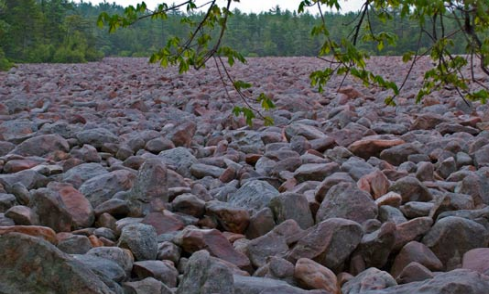
Over 75,000 years ago, the Laurentide Continental Glacier covered most of Canada and some of the northern regions of the United States. When this glacier started to recede 20,000 years ago, rainwater and melted ice began seeping into the porous bedrock. The water would freeze and expand, causing the rocks to crack. This process is known as mechanical weathering. The downward slope of the region combined with the melting permafrost underneath resulted in the movement of the rocks downward, or mass wasting, to create Boulder Field.
In this activity, students will review and discuss weathering, erosion and mass wasting, to gain a stronger understanding of how Hickory Run’s Boulder Field was formed after the Laurentide Continental Glacier receded. Using edible materials, students will model and demonstrate the geological processes that formed this unique feature.
Grade Level: 6th – 8th grade
Subject Matter: Geology
National Standards: NS.5-8.1, NS.5-8.4
Tucked in a shallow valley in northeastern Pennsylvania is a mysterious geologic feature: 16 acres of sandstone boulders. Science Friday took a trip to Hickory Run State Park’s Boulder Field, and spoke to Megan Taylor, environmental education specialist, about why the rocks collected there.
Activity Materials
Shallow baking pan
Gelatin
Decorating icing tube with piping tip – one for each student
Paper plates – one for each student
Plastic coffee stirrers (must be cylindrical stirrers) – one for each student
Roll of paper towels
Vocabulary
Erosion: the movement of loose rock or soil as a result of ice, wind or water.
Glacier: a large, slow-moving mass of ice and compacted snow that travels over land.
Geology: the study of the structure of the Earth, including its rocks, soil and minerals.
Mass Wasting: the movement of loose rock material down a slope, due to the force of gravity.
Mechanical Weathering: the breaking down of rocks and minerals into smaller loose pieces, without altering the chemical makeup of the material.
Permafrost: soil that remains permanently frozen.
What To Do
Prep: Prepare gelatin according to directions on the packaging, using a shallow baking pan. After the gelatin is set, place the bottom of the pan in hot water to loosen the gelatin. Gently turn the pan upside down, and allow the gelatin to slip out onto a flat tray or plate. Cut the gelatin into cubes one inch high, two inches long, and two inches wide. For each student or pair of students, place one gelatin cube on a paper plate.
1. Begin the lesson by having students watch the Science Friday video, “This Field Rocks.” Start a discussion with students on how Hickory Run’s Boulder Field was formed, and what roles weathering, mass wasting, gravity and permafrost played in this process. Tell the students that they are going to use gelatin and icing to demonstrate how these processes formed Boulder Field.
2. Have students create a chart with two columns labeled “Boulder Field” and “Laboratory,” respectively. Students will be using the Boulder Field column to record what they observed from the video. In the Laboratory column, students will record their observations from this activity.
3. Have students write “sandstone bedrock” under the Boulder Field column. Ask students to recall from the video what the surface of sandstone is like, and to record this information in the same column. Students also can draw a sketch illustrating the porous texture of sandstone.
4. Passing out the gelatin cubes on paper plates, have students observe the surfaces. After students have written the word “gelatin” under the Laboratory column, have them record their observations in the same column. Ask students to describe the differences between the gelatin cube and sandstone.
5. Tell students that their cube is going to represent the sandstone bedrock. Have students suggest ways to make the flat, smooth surface of the gelatin cube similar to the porous surface of sandstone.
6. After taking suggestions from students, pass out cylindrical coffee stirrers and have students gently poke holes into the gelatin. Under the Laboratory column, have students describe how they used the coffee stirrer to make the gelatin more porous. Additionally, have them sketch a diagram of what their gelatin looks like after poking holes.
7. Review the definition of mechanical weathering and erosion. Compare and contrast the two terms, reminding students that mechanical weathering is what caused the boulders to form, not erosion. 
Have students recall from the video what caused the sandstone to split into boulders.
8. Ask students to predict what will happen if icing is used to fill the holes in the gelatin. Have students test their predictions by squeezing icing onto each gelatin cube, and filling the holes made by the coffee stirrer. What happens to the gelatin as icing continues to fill the holes?
9. Have students record the effects of the icing in the gelatin under the Laboratory column. Ask students to describe how this demonstrates the weathering of sandstone at Hickory Run State Park. Record this information under the Boulder Field column.
10. Have students poke holes in the smaller pieces of gelatin as they break apart from the larger piece. Fill these new holes with icing. Ask students to describe how this can be compared to the type of weathering that occurred at Boulder Field.
11. Review the definition for mass wasting, and ask students to recall how the boulders were transported to Boulder Field. In the Boulder Field column, have students sketch a diagram that illustrates how permafrost, gravity and slope caused mass wasting.
12. Ask students to think about how they can demonstrate mass wasting in the classroom with their gelatin boulders. Have each student slowly lift and prop up the paper plate on an angle. What happens to the broken pieces of gelatin? Have students record their observations under the Laboratory column.
13. Have students sketch a diagram of their activity that completely illustrates the processes of mass weathering, in comparison to the creation of Boulder Field. The diagram should include the gelatin as sandstone being broken into smaller pieces (mechanical weathering), and traveling down the slope of the plate (mass wasting). Ask students why scientists might use similar methods to model science concepts in a laboratory setting.
14. Make sure to check for any possible food allergies before allowing students to eat their model. Invite students to eat their models, as they discuss their understanding of the differences between weathering, erosion, and mass wasting.
What’s Happening?
The formation of Hickory Run Boulder Field was a combination of mechanical weathering and mass wasting. When the Laurentide Continental Glacier began to recede and melt almost 20,000 years ago, the resulting water, along with rainwater, started to seep into the porous surface of the sandstone bedrock. At night when the temperate fell below freezing, the water would freeze and expand. During the day, when the temperature rose, the water would melt again. The expansion of frozen water caused cracks in the bedrock and the formation of smaller loose pieces of sandstone. This type of geological process is called mechanical weathering. The one-degree slope, in combination with the thawing of the underlying permafrost, caused mass wasting, or a downward movement of the boulders.
In this activity, the gelatin cube covered in small holes represents the sandstone bedrock after the Laurentide Continental Glacier receded. The icing represents the rainwater or melted ice that seeped into the bedrock. The gelatin cube or “bedrock” will begin to crack, due to the pressure of the icing expanding or “water freezing,” creating smaller gelatin pieces or “boulders”. By angling the paper plate to imitate the one-degree slope, mass wasting occurs causing a “boulder field” of gelatin.
Topics for Science Class Discussion
• How is erosion different from mechanical weathering?
• What are the other types of weathering besides mechanical weathering?
• Would the same geological processes have happened if the bedrock had not been porous?
• Why is it important for scientists to study glaciers?
Extended Activities and Links
Fill an ice tray half way with water and place in a freezer over night. Make observations of how water expands when frozen, and research other liquids to see if they share the same characteristic.
Have the students research past and present glaciers. How do these immense masses of ice affect the geological structures of an area? Are there any geological features in their neighborhood that were caused by glaciers? Students can create models of geological features that are direct results of glaciers and present their work to the class.
Have students research online videos that depict different types of mass wasting including creeps, slides, flows, topples, and falls. How do these examples of mass wasting affect the environment?
Start a rock collection with some helpful hints from the United States Geological Survey (USGS):
http://pubs.usgs.gov/gip/collect1/collectgip.html
Make a model of a glacier fluid flow:
http://www.newtonsapple.tv/TeacherGuide.php?id=1657
Explore earth science on the National Museum of Natural History’s interactive website:
http://www.mnh.si.edu/earth/main_frames.html
Learn about precarious rocks:
http://www.sciencedaily.com/releases/2007/02/070228170312.htm
This lesson plan was created by the New York Hall of Science in collaboration with Science Friday as part of Teachers Talking Science, an online resource for teachers, homeschoolers, and parents to produce free materials based on very popular SciFri Videos to help in the classroom or around the kitchen table.
 The New York Hall of Science is a science museum located in the New York City borough of Queens. NYSCI is New York City’s only hands-on science and technology center, with more than 400 hands-on exhibits explore biology, chemistry, and physics.